
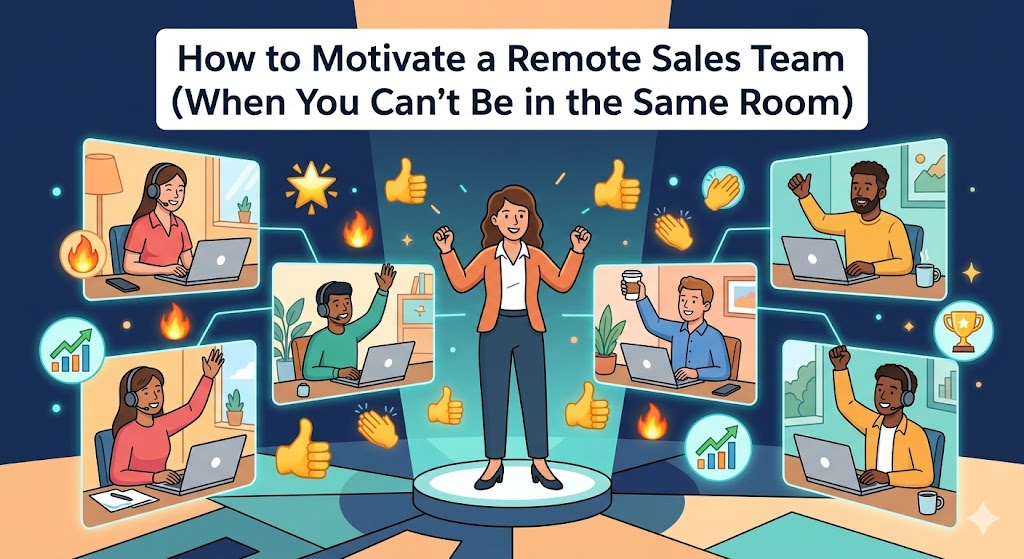
Sales motivation used to be easy.
Someone closed a deal and everyone heard it. The leaderboard on the wall told the whole team exactly where they stood. The energy in the room on a good day was contagious — someone on a hot streak lifted everyone around them without trying. None of that required a manager to organise it. It just happened.
When your team goes remote, all of it disappears. Not because your people have changed, but because the conditions that fed their motivation are gone. And most sales managers respond by doing more of what they did in the office — more meetings, more check-ins, more messages — and wonder why it's not working.
You can't recreate the office. But you can build something that works better.
Why Remote Sales Motivation Is a Different Problem
Most sales motivation advice was written for managers who can walk the floor. The tips assume proximity — a leaderboard on the wall everyone walks past, a team huddle where energy is visible, a manager who notices when someone's having a bad day and pulls them aside.
Remote teams don't get any of that passively. Every motivational moment has to be deliberate. That's the shift most managers don't fully make, and it's where remote sales performance quietly falls apart. It's not dramatic. It's a slow drain — slightly less competitive energy, slightly less recognition, slightly more isolation — until one day your best rep tells you they're leaving and it comes out of nowhere.
It didn't come out of nowhere.
What Actually Motivates Salespeople (It's Not Commission)
Commission gets people through the door. It doesn't make them perform at their best once they're there.
I've spoken to hundreds of sales managers and business owners building remote teams. The ones with the highest-performing people aren't the ones paying the most. They're the ones who've figured out what actually drives performance once the baseline compensation is sorted.
Four things come up consistently:
Visibility of progress. Salespeople are competitive by nature. They want to know where they stand — against their own target, against their peers. That information is motivating in a way that a pep talk never is.
Recognition. Wins need to be seen. Not in a Friday summary email. In the moment, publicly, in front of the team. Recognition that happens too late or too quietly barely registers.
Belonging. Remote working can be isolating in a way that erodes motivation slowly. People perform better when they feel part of something — a team with momentum, a shared mission, a culture that feels real even over a screen.
Competition. The healthy kind. A leaderboard that's visible, targets that everyone knows about, moments where the stakes feel real. Competition without visibility is just pressure. Competition with visibility is fuel.
Remote teams lose access to all four unless the manager builds them in deliberately.
The Remote Motivation Killers to Fix First
Before adding anything new, audit what's already draining motivation:
Wins going unrecognised. A rep closes a deal on Tuesday afternoon. The manager finds out on Thursday. By the time anyone says anything, the moment is gone. This happens constantly in remote teams and the cumulative effect is devastating.
No visibility into peer performance. In an office, everyone knows roughly who's winning. Remote teams often have no idea. People work in their own bubble, with no competitive context and no sense of where they fit.
Targets that feel abstract. A quarterly target with no daily or weekly progress indicators leaves reps with nothing to work against day-to-day. The number feels distant. The motivation drains.
Isolation. The most underrated motivation killer. Doing the same job, alone, with no team energy around it, wears people down in ways they don't always articulate until they've already decided to leave.
Fix these before you do anything else. Motivational messages sent on top of these problems don't move the needle.
How to Motivate a Remote Sales Team Day-to-Day
Five things that consistently work for the managers I speak to — and in our own experience building a remote-first team:
Make wins visible immediately. Not at the Friday meeting. Not in a weekly roundup. The moment it happens. A deal closes at 2pm — the team knows by 2:01pm. That moment of public acknowledgement is worth more than any end-of-week summary.
Make performance visible to everyone. Real-time leaderboards and live target progress aren't about surveillance — they're about giving people the context to motivate themselves. When a rep can see they're third on the leaderboard and within striking distance of second, they don't need a manager to push them.
Build peer recognition in. Top-down recognition from a manager matters, but peer recognition — colleagues acknowledging each other — creates team culture that doesn't depend on the manager being the source of all motivation. Give your team a way to celebrate each other. Use it.
Check in on the person, not just the pipeline. A one-to-one that's only ever about deals teaches reps to perform for the CRM. Ask how they're doing. Notice when someone's energy is off. The pastoral side of sales management matters more in remote teams than it ever did in an office.
Create competitive moments deliberately. Short activity sprints. Team challenges. First to X gets Y. These don't need to be elaborate — they need to be visible and real-time. Manufacture the competitive energy the office used to create by accident.
How to Motivate When Results Are Down
Every team goes through a slow patch. How a manager handles it defines the team's recovery.
Don't pretend it isn't happening — silence from the top when results are down reads as either obliviousness or indifference. Neither helps.
Shift the focus to activity. Results are partly outside a rep's control. Calls made, proposals sent, meetings booked — these aren't. Recognising strong activity during a difficult period keeps effort high even when conversion is low.
Break the big target into smaller milestones. A monthly target that feels unreachable by the 15th kills motivation for the rest of the month. Weekly or even daily markers give people something to push against every day.
And recognise effort explicitly. The rep who makes 60 calls in a tough week and books nothing has done something worth acknowledging. If you only recognise results, you teach your team to slow down when results aren't coming.
What the Best Remote Sales Managers Do Differently
They don't wait for the Friday meeting.
They've built systems — intentional ones — so that wins surface immediately, performance is visible in real time, and recognition happens in the moment it means most. They treat visibility as a management tool, not a surveillance tool. And they understand that for a remote team, culture is something you build deliberately or it doesn't exist at all.
The managers I've seen struggle with remote teams are almost always the ones still running the same processes they ran in the office, wondering why the energy isn't the same. It won't be the same. But it can be just as good — if you build for it.
Five Things to Do This Week
- Find a win from the last week that went unrecognised. Mention it publicly — today.
- Make your team's target progress visible to everyone, in real time.
- Create one way for your team to recognise each other this week — a channel, a board, anything.
- In your next one-to-one, ask how your rep is doing before you ask about their pipeline.
- Run one short activity sprint — 48 hours, one metric, everyone can see the leaderboard.
Frequently Asked Questions
How do you motivate a remote sales team?
The key shift is moving from passive motivation (the energy of an office, a visible leaderboard on the wall) to deliberate motivation. Make wins visible immediately when they happen, keep performance data visible to everyone in real time, build in peer recognition, and create competitive moments intentionally. Every motivational moment that used to happen by accident in an office has to be engineered for a remote team.
What actually motivates salespeople day-to-day?
Commission gets people through the door, but it doesn't drive day-to-day performance. What consistently matters more is visibility of progress (knowing where they stand against targets and peers), timely recognition, a sense of belonging to a team with real momentum, and healthy competition. Remote teams lose access to all four unless the manager builds systems to recreate them.
Why do remote sales teams struggle with motivation?
The most common culprits are wins going unrecognised, no visibility into what peers are doing, targets that feel abstract without daily progress markers, and isolation. These problems compound slowly — it rarely looks like a crisis until a good rep hands in their notice. Fixing these four things before adding anything else will have more impact than any motivational initiative.
How do you create competition in a remote sales team?
Use real-time leaderboards so everyone can see where they stand, and run short activity sprints with visible stakes — 48 hours, one metric, everyone on the same board. The competition doesn't need to be elaborate; it needs to be visible and timely. Competition without visibility is just pressure. Competition with visibility is fuel.
How should you handle a remote sales team when results are down?
Don't stay silent — silence reads as obliviousness or indifference. Shift the focus to activity metrics that are within a rep's control (calls made, meetings booked, proposals sent) and recognise strong effort even when conversion is low. Break the remaining target into smaller weekly or daily milestones so there's always something to push against. If you only recognise results, you teach your team to slow down when results aren't coming.
What's the biggest mistake managers make with remote sales teams?
Running the same processes they used in the office and expecting the same results. The energy, visibility, and spontaneous recognition that happened naturally in an office don't transfer remotely — they disappear unless you build deliberate systems to replace them. The managers with the highest-performing remote teams treat motivation as something you design, not something that just happens.