
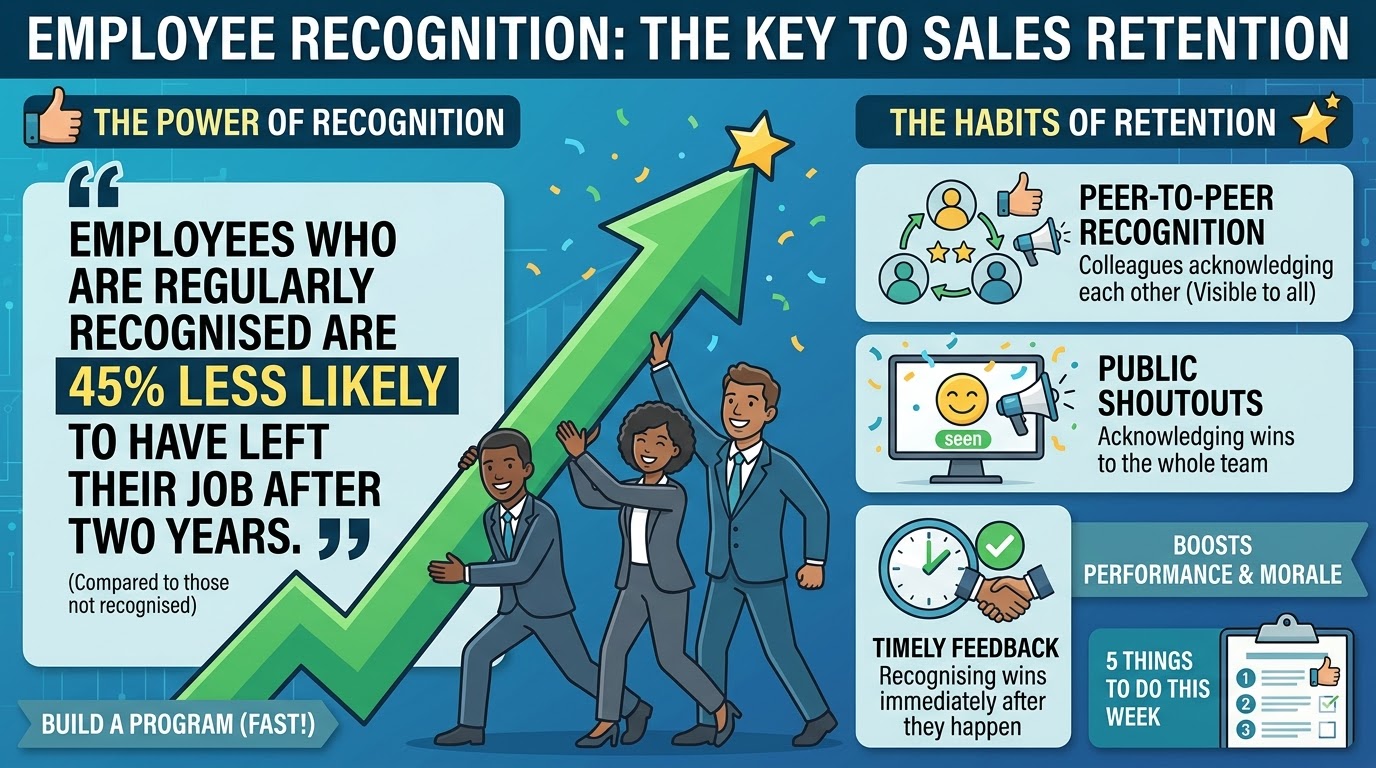
Here's a number that stopped me in my tracks when I first read it: employees who are regularly recognised are 45% less likely to have left their job after two years.
For a sales team, do the maths on that. Replacing a sales rep costs somewhere between six months and a year of their salary — recruitment fees, lost pipeline, the time it takes a new person to get up to speed. And most of the time, it wasn't the money that made them leave. It was feeling invisible.
Building an employee recognition program doesn't require an HR department, a big budget, or a company-wide rollout. It requires consistency, intention, and the right habits. This guide is the practical version — written for business owners and sales managers who know recognition matters but haven't had time to build anything formal yet.
What Is an Employee Recognition Program?
An employee recognition program is a structured way of acknowledging what your people do well — regularly, consistently, and in a way that actually lands.
It's worth separating recognition from rewards. Recognition is the acknowledgement — the public callout, the message, the moment someone feels seen. Rewards are the tangible thing attached to it — a voucher, a bonus, a prize. The two work well together, but recognition alone is more powerful than most managers realise. People want to feel valued. A reward without recognition is just a transaction.
A program isn't a formal document or a committee. It's a set of habits your team can rely on.
Why Recognition Matters More for Sales Teams
Most recognition advice is written for HR teams thinking about the whole workforce. Sales teams are different, and they need treating differently.
Sales is inherently a high-visibility job. Targets are public. Performance is measurable. People know who's ahead and who's behind. That environment creates natural motivation — but it also means that when wins go unnoticed, the drop in morale is sharper than in other roles.
When your best rep closes a deal and nobody mentions it until the Friday meeting, something breaks. They did the work, they hit the number, and the response was silence. Over time, that silence accumulates.
This problem gets worse in remote and hybrid teams. In an office, a win has a natural moment — someone shouts across the floor, there's a round of applause, people feel it. When your team is distributed, that moment disappears unless you deliberately recreate it. Recognition doesn't happen by accident anymore. You have to build it in.
Types of Employee Recognition
There are three useful ways to think about recognition:
Formal vs informal. Formal recognition is structured — employee of the month, quarterly awards, annual bonuses. Informal recognition is in-the-moment — a message when someone closes a deal, a shoutout in a team meeting. Both matter, but most businesses have formal recognition and almost no informal recognition. The informal version is what people actually remember.
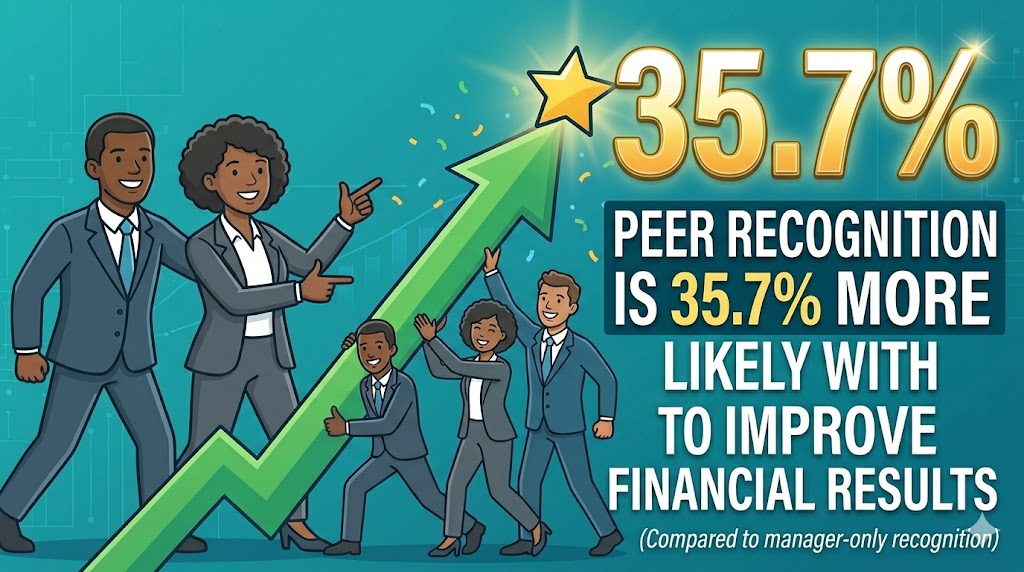
Manager-led vs peer-to-peer. Top-down recognition from a manager carries weight, but peer recognition — colleagues acknowledging each other — has a measurable impact on performance. Research by SHRM and Globoforce found that peer recognition is 35.7% more likely to improve financial results than manager-only recognition. It also builds the kind of team culture you can't manufacture from the top.
Public vs private. For sales teams especially, public recognition outperforms private. A private message is appreciated. A public acknowledgement — in front of the whole team — is motivating in a way that ripples outwards. It tells the rest of the team what good looks like. It makes the person feel valued in front of their peers.
How to Build an Employee Recognition Program from Scratch
You don't need to overcomplicate this. Here's what actually needs to happen:
1. Decide what you're recognising. Results matter — deals closed, targets hit, revenue generated. But don't stop there. Recognise effort, behaviours, and milestones too. The rep who makes 50 calls on a hard day and books nothing deserves recognition as much as the one who closes on a lucky run of warm leads.
2. Choose your mix. Aim for a combination of informal (in-the-moment) and formal (structured). If you only have formal recognition, the gaps between acknowledgements are too long. People need to feel seen regularly, not just at the end of the quarter.
3. Make it timely. The further recognition is from the moment, the less impact it has. Recognise as close to the win as possible. If you find out about a success three days later, the moment has passed.
4. Make it visible. For sales teams, public recognition is the point. Find a way to surface wins to the whole team — not just the manager's inbox.
5. Enable peer recognition. Don't make all recognition flow from you. Create a way for team members to acknowledge each other. This is where team culture actually lives.
How Often Should You Recognise Employees?
The honest answer: more often than you think.
Most businesses rely on annual reviews or quarterly awards. That's not enough. Research consistently shows that frequent, timely recognition — even for small wins — outperforms infrequent large gestures.
The risk of recognising too often is low. The risk of not recognising enough is real — disengagement, reduced effort, and eventually, people leaving.
A rough target: no team member should go more than a week without some form of acknowledgement for their work. That doesn't have to be a formal award. It can be a message. A shoutout. A moment.
What Good Recognition Looks Like in Practice
For a sales team, good recognition looks like this:
- A deal closes. The whole team sees it in real time — not at the Friday meeting.
- Someone has a strong activity day — most calls made, most proposals sent. That gets noticed and called out, even if nothing converted.
- A new rep books their first meeting. The team celebrates it like a big deal, because for them it is.
- A peer nominates a colleague for helping them prepare for a pitch. That nomination is visible to everyone.
- A long-tenure milestone gets marked properly — not with a generic email, but with a genuine acknowledgement of what that person has contributed.
None of these require a big budget. They require attention and consistency.
What Should a Small Business Budget for Recognition?
Formal reward programmes typically benchmark at 1–2% of payroll. For a small business, that might feel steep — but most of that budget goes on the moments that matter most (annual awards, milestone gifts, team events).
The most impactful forms of recognition cost nothing. Public acknowledgement, peer shoutouts, timely feedback — these are free. Where budget helps is in adding tangible rewards to reinforce the recognition: vouchers, experiences, or in-app points that team members can redeem over time.
Start with the habits. Add rewards as the programme matures.
Five Things to Do This Week
- Identify the last three wins your team had that went unrecognised. Mention them — now, not at the next meeting.
- Find one way to make recognition visible to the whole team, not just the person being recognised.
- Create a simple way for team members to recognise each other — a Slack channel, a shared board, anything.
- Set a reminder to recognise at least one person every day this week. Notice how quickly it becomes a habit.
- Ask your team what recognition means to them. You might be surprised by the answers.
Frequently Asked Questions
What is an employee recognition program?
An employee recognition program is a structured approach to acknowledging what your team members do well — consistently, and in a way that actually lands. It's a set of habits, not a formal document. The goal is to make people feel seen regularly, not just at annual reviews or when something goes wrong.
What's the difference between employee recognition and rewards?
Recognition is the acknowledgement — the public callout, the message, the moment someone feels seen. Rewards are the tangible thing attached to it, such as a voucher, bonus, or prize. Recognition alone is more powerful than most managers realise; a reward without recognition is just a transaction.
How often should you recognise employees?
More often than most businesses currently do. Research consistently shows that frequent, timely recognition — even for small wins — outperforms infrequent large gestures. A practical target for sales teams: no team member should go more than a week without some form of acknowledgement for their work.
What types of employee recognition are most effective for sales teams?
For sales teams, public recognition outperforms private. Peer-to-peer recognition is also significantly more impactful than many managers expect — research by SHRM and Globoforce found it is 35.7% more likely to improve financial results than manager-only recognition. The most effective programmes combine in-the-moment informal recognition with occasional formal recognition.
How much should a small business spend on employee recognition?
Formal reward programmes typically benchmark at 1–2% of payroll. But the most impactful forms of recognition — public acknowledgement, peer shoutouts, timely feedback — cost nothing. Start with building the habits, then add tangible rewards as the programme matures.
How do you recognise remote employees effectively?
The key is making recognition visible in real time, not saving it for the next team meeting. When a win happens, the whole team should see it immediately — not find out days later. For distributed teams, this means having a deliberate system in place, whether that's a dedicated Slack channel, a recognition tool, or a consistent habit of calling out wins in public channels as they happen.